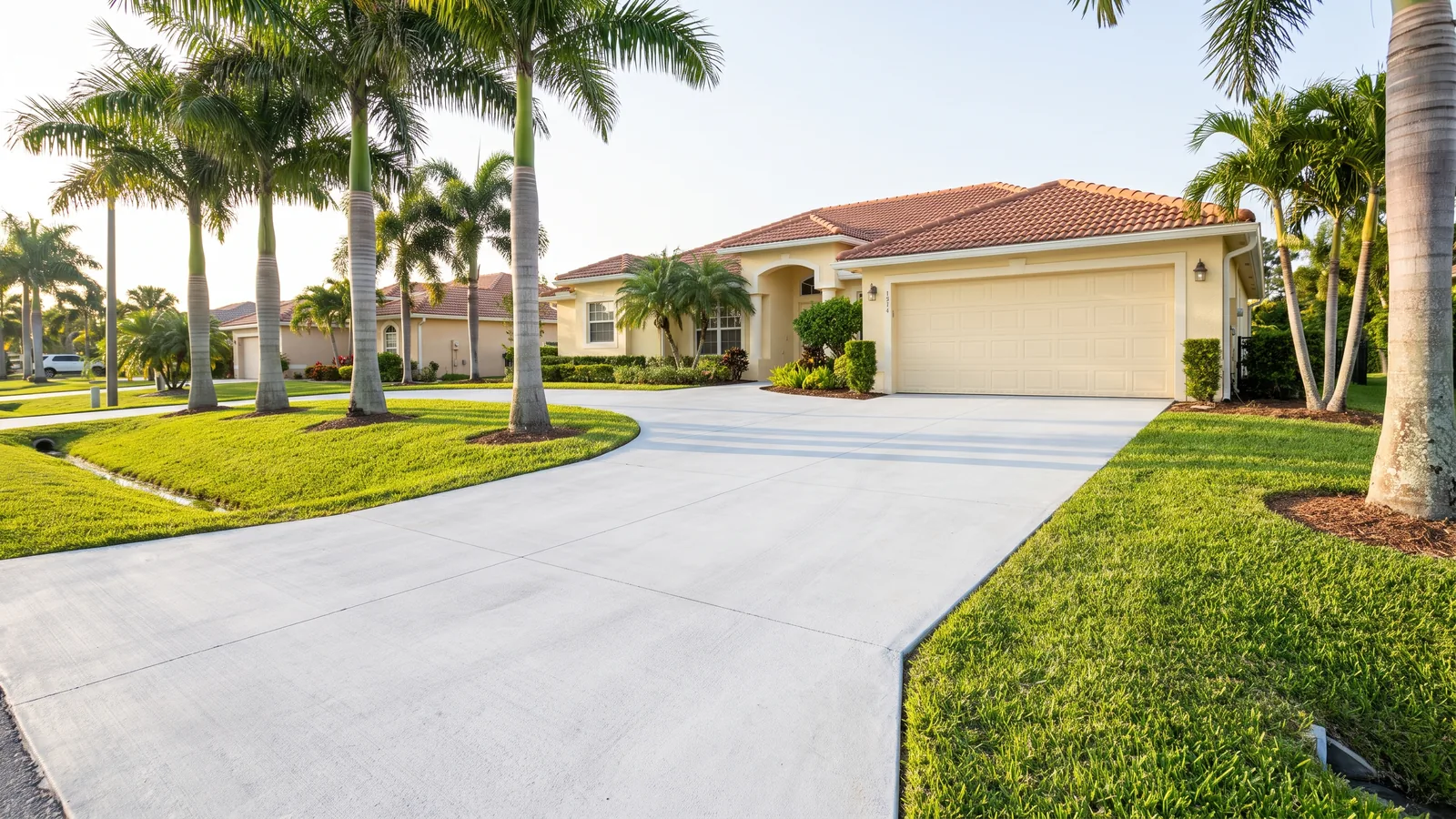
The short answer for 2026: a new reinforced, broom-finished concrete driveway in Port St. Lucie costs $8 to $12 per square foot, so $4,500 to $7,500 for a typical two-car drive of 550 to 650 square feet. Demolition of an old driveway adds $3 to $5 a square foot; a culvert and apron across the swale adds $4,500 to $8,000 where the city requires one; stamped or decorative finishes roughly double the per-foot price. Here's the full breakdown.
Driveway prices by size and finish
| Driveway | Broom finish | Exposed / knockdown | Stamped |
|---|---|---|---|
| Single car (12 × 30, 360 sq ft) | $3,200 – $4,500 | $4,000 – $5,800 | $5,400 – $8,000 |
| Two car (20 × 30, 600 sq ft) | $4,800 – $7,200 | $6,300 – $9,000 | $8,500 – $13,000 |
| Two car + third pad (800 sq ft) | $6,400 – $9,600 | $8,400 – $12,000 | $11,500 – $17,500 |
| Circular drive (1,100 sq ft) | $8,800 – $13,000 | $11,500 – $16,500 | $16,000 – $24,000 |
Prices are for a 4-inch reinforced slab on a compacted base with control joints, a thickened apron, and cleanup. Demolition, culverts and permits are itemized separately below.
What's in the base price
Excavation and grading; a compacted base (Port St. Lucie's sand compacts well when it's done in lifts with a plate compactor — it fails when it's just raked); fiber or wire reinforcement; 3,000-psi concrete four inches thick, six at the apron; control joints every 8 to 10 feet; a broom finish; and a joint at the garage and the apron.
What adds to it
Demolition — $3 to $5 per square foot
Breaking out and hauling the old driveway. Thick old slabs, or ones with a lot of wire, cost more.
Culvert and apron — $4,500 to $8,000
On GDC lots the driveway crosses the swale, and the city requires a right-of-way permit, a culvert pipe sized by Public Works, mitered ends and an apron to the city detail. If your existing crossing has a good pipe, only the apron is replaced ($1,400 to $2,800). Details on the culvert page.
Thickness — $1 to $2 per square foot
Five or six inches for a boat, RV or heavy truck. Worth it if anything over 8,000 pounds parks there.
Finishes
Exposed aggregate or knockdown adds $2 to $4 a square foot; stamped concrete $6 to $10; a paver border $8 to $14 per linear foot. Integral color $1 to $2 per square foot.
Permits
City of Port St. Lucie building permit for a new or replaced driveway and the ROW permit for the apron: $150 to $450 in fees plus our handling, all shown on the quote.
Access and trees
A driveway a mixer can't reach (pump or buggy pour) adds $400 to $900. Root removal under an old driveway is priced when we see it.
Concrete vs. pavers vs. asphalt
Pavers run $14 to $22 a square foot installed here, and their advantage — you can lift and reset them when the sand washes out — is real on the lots that flood. Asphalt is $5 to $8 but softens in the Florida sun and needs sealing; almost nobody puts it on a house here. Concrete is the middle: durable, lower maintenance, and cheaper than pavers, as long as the base is done right. Our concrete-vs-pavers guide goes deeper.
Common questions
Is $6,000 a fair price for a driveway in Port St. Lucie?
For a two-car reinforced broom-finished driveway with demolition, yes — that's the middle of the 2026 range. Under $4,000 for the same job usually means no base compaction or no reinforcement; over $9,000 means a culvert, a decorative finish, or a quote to compare.
How much does it cost to widen a driveway?
$10 to $14 per square foot for a widening strip, because it's a small pour with the same setup; a 3-foot by 30-foot strip is about $1,000 to $1,300. The city limits driveway width on the frontage; we check first.
Do I need a permit for a driveway in Port St. Lucie?
Yes for a new or replaced driveway, and a separate right-of-way permit for the apron and culvert at the swale. Repairs and resurfacing of an existing driveway usually don't need one.
How long before I can park on a new driveway?
Walk on it in 24 hours, park a car after 7 days, park a truck or boat after 28 days. Concrete keeps gaining strength for a month.
Can I finance a driveway?
Yes — we offer financing through a third-party lender, and many homeowners use a HELOC or a card for a driveway-sized job.
Related: Driveways · Culverts & aprons · Concrete vs. pavers · Why concrete sinks in Florida