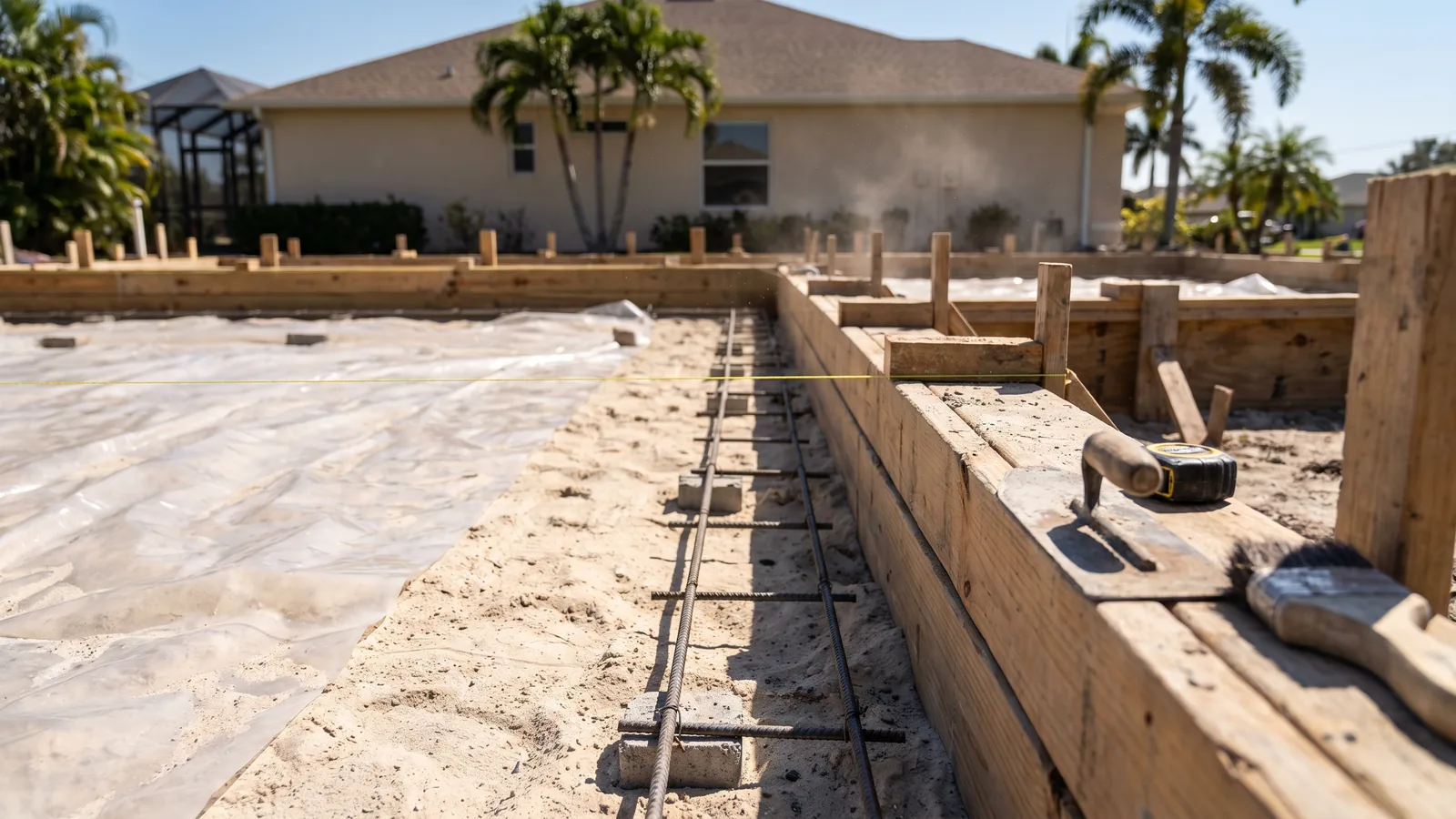
Thickness is the question everybody asks and the one that matters least by itself. A six-inch slab on raked sand will sink; a four-inch slab on a compacted base with reinforcement will last thirty years. Here's what actually goes into a slab that holds up in Port St. Lucie, by project.
Thickness by project
| Slab | Thickness | Reinforcement | Concrete |
|---|---|---|---|
| Walkway, patio, lanai extension | 4 in | Fiber or 6×6 wire mesh | 3,000 psi |
| Pool deck | 4 in | Fiber + mesh; expansion joint at coping | 3,000 psi |
| Driveway (cars) | 4 in, 6 at the apron | Fiber or mesh; #4 rebar at the apron | 3,000 psi |
| Driveway or pad (boat, RV, heavy truck) | 5–6 in | #4 rebar 18 in on center | 3,500 psi |
| Shed / workshop pad | 4 in, thickened edge | Mesh + #4 in the edge | 3,000 psi |
| Generator / AC pad | 4–6 in | Mesh; anchor bolts to the unit | 3,000 psi |
| Foundation (addition, garage) | 4 in + 16–20 in footing | #5 in footing, mesh in slab — per engineer | 3,000 psi+ |
| Dumpster pad, dock apron | 8 in | #4–#5 rebar both ways | 4,000 psi |
Reinforcement: fiber, mesh or rebar?
Fiber (synthetic macro-fibers mixed into the concrete) controls shrinkage cracking and is what most residential flatwork uses now — it can't be left lying at the bottom of the slab the way mesh often is. Wire mesh works if it's actually held in the middle of the slab on chairs; it's useless on the ground. Rebar is for loads — boat pads, aprons, thickened edges, footings — and for anything an engineer designs. We use fiber in nearly everything, mesh where an HOA or a plan calls for it, and rebar where the weight is.
PSI
3,000 psi is the residential standard and plenty for cars and people. 3,500 for boat and RV pads; 4,000 for commercial and dock aprons. Higher-strength concrete also has less water in it, which means fewer shrinkage cracks — worth the small upcharge on a driveway.
The base
On sand: excavate to depth, compact the native sand in 4-inch lifts with a plate compactor, and only bring in fill if the grade needs it. Crushed rock isn't necessary on well-drained sand and can actually hold water in a low lot. A vapor barrier goes under slabs that will be inside or coated; not under a driveway. Slabs are pitched an eighth of an inch per foot away from the house.
Joints
Control joints a quarter of the slab depth, spaced at 24 to 30 times the thickness — 8 to 10 feet for a 4-inch slab — cut or tooled the same day. Expansion joints against the house, the pool coping, and any other slab. Skipping joints is the fastest way to get a crack across the middle of the driveway.
Common questions
Is a 4-inch driveway thick enough?
For cars, yes — 4 inches reinforced on a compacted base is the standard and lasts decades. Go to 5 or 6 inches with rebar if a boat, RV or anything over about 8,000 pounds will park on it, and always 6 at the apron where trucks turn in.
Is fiber as good as wire mesh?
For crack control in flatwork, as good or better, because it's distributed through the whole slab and can't end up on the bottom. For carrying loads, neither one substitutes for rebar.
Do I need rebar in a patio?
No — fiber or mesh handles shrinkage cracking in a 4-inch patio. Rebar goes where there's real load or a thickened edge.
What PSI concrete for a driveway?
3,000 psi is standard; 3,500 is a cheap upgrade that cracks less. Ask for the mix on the quote.
How thick for a boat pad?
Five to six inches with #4 rebar on 18-inch centers, 3,500 psi, on a compacted base — for a boat and trailer up to about 12,000 pounds. Bigger than that, we size it to the load.
Related: Slabs & pads · Foundations & additions · Driveways · Why concrete sinks