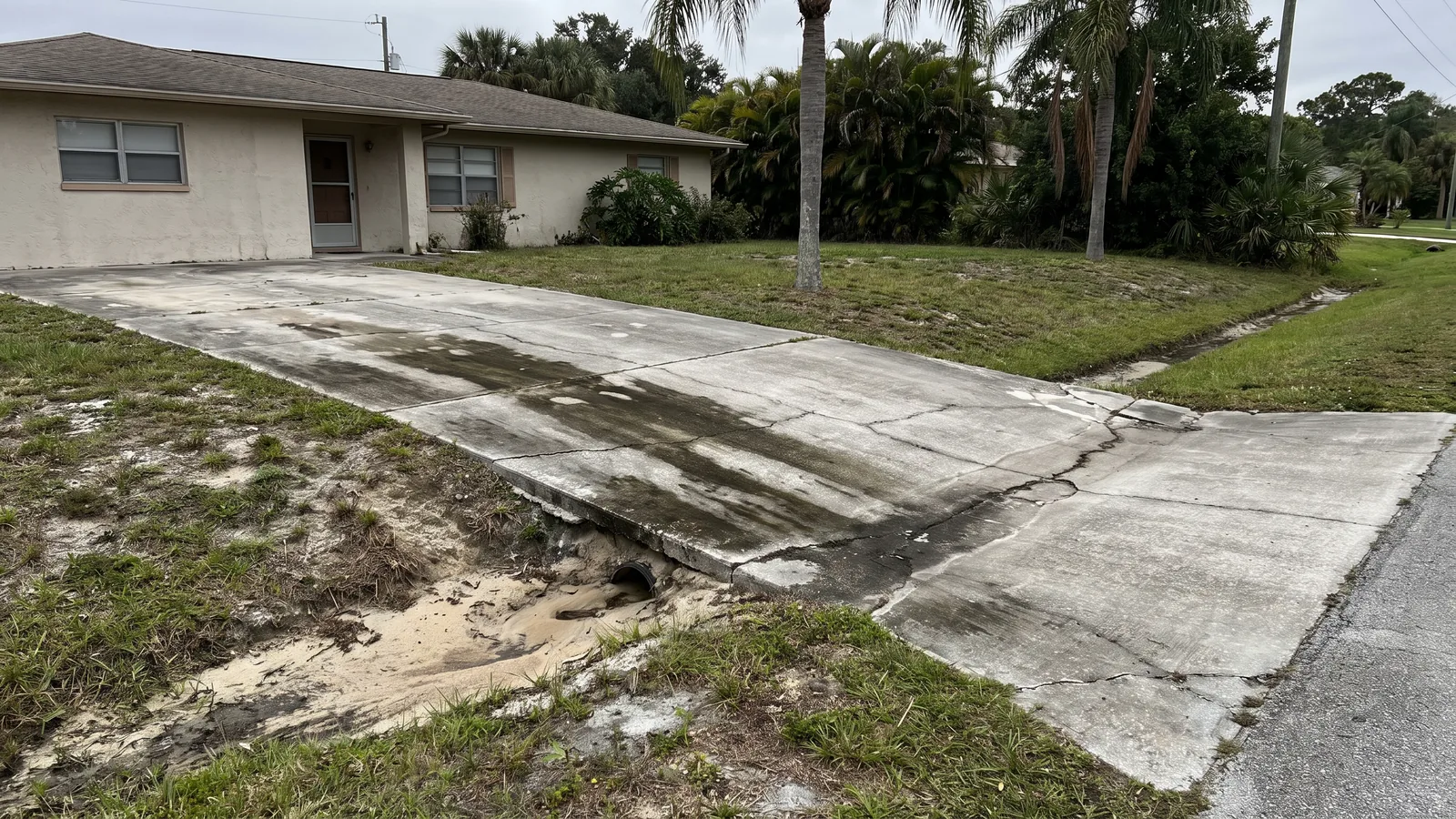
Concrete doesn't sink; the ground under it does. In Port St. Lucie that ground is fine sand over a water table that rises to within a foot or two of the surface every summer, and when water moves through sand it takes sand with it. Every sunk driveway, tilted walkway and lifted pool deck we see comes down to one of a handful of causes.
The causes
Washout from sprinklers and downspouts
The number-one cause. An irrigation head that sprays the driveway edge, or a downspout that dumps at the corner of the pool deck, runs water under the slab every day. The sand goes with it, the slab is left over a void, and it sinks — usually at exactly the corner nearest the water.
No base, or a raked one
A lot of GDC-era flatwork was poured on the sand as it lay. Sand has to be compacted in lifts with a plate compactor to hold a slab; raked sand consolidates under load for years. This is why a 1990s driveway sinks evenly along its whole length.
Wet-season water table
Lots near the canals, the North Fork and the low spots in Sandpiper Bay and River Park have water at the surface in August. Saturated sand loses bearing; slabs settle and pump.
Tree roots
Live oaks and ficus lift slabs from below; when the tree is removed the roots rot and the slab drops. Palms are mostly innocent.
No reinforcement
Concrete cracks — that's what control joints are for. Without fiber or mesh, a crack opens and the pieces move independently; with reinforcement, a crack stays tight and the slab still acts as one piece.
Swale and culvert problems
A crushed or missing culvert backs the swale up against the apron and washes out the base under it. The apron cracks first, then the driveway.
The fixes and what they cost
| Fix | Price | When it's right |
|---|---|---|
| Polyurethane foam lifting | $500 – $2,500 | Sound slab, sunk up to a few inches, large pieces. Done in a morning; drive on it in an hour. |
| Mudjacking (slurry) | $400 – $2,000 | Older method; heavy slurry can re-settle in sand. We prefer foam here. |
| Crack routing and filling | $200 – $800 | Non-moving cracks; keeps water out of the base. |
| Section replacement | $14 – $20 / sq ft | One broken panel in an otherwise sound driveway. |
| Full replacement on a compacted base | $8 – $12 / sq ft | Cracked into small pieces, spalled, or sunk beyond lifting. |
| Fix the water first | $150 – $900 | Move the sprinkler head, extend the downspout, replace the culvert. Always. |
How we prevent it on new work
Base compacted in lifts and tested by feel and probe; fiber or wire reinforcement in every slab; four inches minimum, six at aprons and pads; control joints at the right spacing; slabs pitched to drain; sleeves under the slab for irrigation lines so nobody has to cut it later; and a conversation about where the sprinklers and downspouts go, because the best base in the county won't survive a downspout aimed at it.
Common questions
Can a sunken driveway be fixed without replacing it?
Usually, if the slab is in a few large sound pieces: polyurethane foam injection lifts it back to level in a morning for $500 to $2,500. If it's cracked into small pieces or spalled, replacement is the better spend.
Is foam lifting permanent?
As permanent as the base under it. Foam doesn't wash out like sand, and it's waterproof, so it holds — as long as the water that caused the washout is redirected. We fix the sprinkler or the downspout as part of the job.
Why does my new driveway already have a crack?
Concrete shrinks as it cures and will crack somewhere; control joints are cut so it cracks there. A hairline crack at or near a joint in the first year is normal and cosmetic. A wide crack with a lip means the base moved, which is a different problem.
Should I worry about a crack in my pool deck?
Hairline and stable, no — seal it. A crack with one side higher than the other, or one that's growing, means the deck is settling toward the pool and should be lifted before it damages the coping or the shell.
Do palms damage concrete?
Rarely. Palm roots are fibrous and shallow; it's oaks, ficus and mahogany that lift slabs.
Related: Repair, leveling & removal · Culverts & aprons · Driveways · Pool deck resurfacing guide